

Visit Bowie
Bowie history
A railroad town on the old Chisholm Trail, with a pioneering spirit that never left.
Why Bowie?
Bowie in a pecan shell
Bowie was built on a strong, pioneering spirit. It began in the early 1880s, and the town still builds on that history while holding tight to its small-town feel.
We're home to the World's Largest Bowie Knife, the official knife of the State of Texas, and to Second Monday Trade Days, one of the biggest in Texas, less than 60 miles northwest of Dallas–Fort Worth. As it's etched on the knife:
“Attitude is everything when it comes to where you are, where you want to be, and how you are going to get there.”
You'll find over 25 places to eat, two large grocery stores, eight major employers, youth sports, event venues, spas, antique malls, an art gallery, boutiques, a vintage car club, horse-drawn carriage rides, fishing, biking and golf. North Central Texas College's Montague County campus sits on the land that once held the chicken ranch.
The world's largest chicken ranch came first
Long before the knife, Amon G. Carter and Mose Johnson got their start selling chicken and bread sandwiches to travelers stopped at the train depot.
In 1904, Mose and his wife Mabel started out with just $15 and a shoebox full of baby chicks. The M. Johnson Poultry Ranch went on to breed the World's Best Laying Strain of Single Comb White Leghorns, which made Bowie home to the world's largest chicken ranch before it had the world's largest knife.
That's where the Chicken & Bread Days Heritage Festival comes from. Every year on the first Saturday in October, the town celebrates downtown on the original brick streets of Smythe and Tarrant.
Through the years
Early 1860s
Settlers arrive in the area that will become Bowie.
1882
The Fort Worth and Denver railroad comes through. A townsite is laid out in August and a post office applied for.
1883
Bowie incorporates on October 29. D.C. Allen, the town’s first grocer, becomes its first mayor.
1885
The population reaches 1,000.
1893
A second railroad arrives: the Chicago, Rock Island, and Texas.
1904
Mose and Mabel Johnson start out with $15 and a shoebox of baby chicks. Their poultry ranch becomes the world’s largest.
1950s
Bowie approaches 7,000 people.
2016
The World’s Largest Bowie Knife is unveiled on April 4.
2021
The Bowie knife is named the Official Knife of the State of Texas.
A railroad town
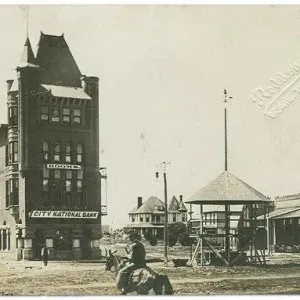
Bowie was settled in the early 1860s, but like a lot of Texas towns it didn't really get going until the railroad came in 1882. Almost overnight it outgrew its tent-city beginnings and became the most important market and banking center between Fort Worth and Wichita Falls.
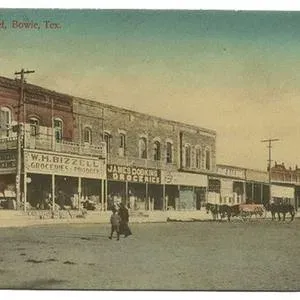
Early on, the town counted five saloons, three livery stables and 50 businesses: dry goods, grocery and hardware stores, a tin shop, drugstores, blacksmiths, two restaurants, a watchmaker and jeweler, and two market houses.
Bowie reached about 2,600 people by 1900, around 3,000 in the 1920s, and close to 7,000 by the 1950s. Today it's home to about 5,700, the largest town in Montague County, a county of about 20,000.
How Bowie got its name
The pioneers and railroad workers who settled here were a hardy, courageous people who endured many hardships, and often risked their lives for each other. So it was fitting to name the town after the Texas hero James “Jim” Bowie, for that same spirit of courage, strength and faith.
Population figures courtesy of TexasEscapes.com (opens in a new tab).
There's plenty to do all year, from rodeos and parades to art and wine festivals, and some of the best sunsets around. Come see for yourself.